
Hebei YUBO Filtration Equipment Co., Ltd. Hebei YUBO Filtration Equipment Co., Ltd.
+86 15732177595
Hebei YUBO Filtration Equipment Co., Ltd. Hebei YUBO Filtration Equipment Co., Ltd.
+86 15732177595
Selecting the right filtration technology has a direct impact on system efficiency, operating cost, and long-term reliability. Among the available options, the wedge wire screen filter is widely used in water treatment, industrial processing, mining, and energy applications.
A wedge wire screen filter is the right choice when your filtration system demands:
Reliable, repeatable separation
High flow with low pressure loss
Resistance to clogging
Long service life in industrial conditions
While it may not replace fine filtration technologies in all cases, it excels as a primary or protective filtration component across water, wastewater, and industrial processes.
A wedge wire screen filter is a rigid filtration element manufactured by welding V-shaped (triangular) wire onto longitudinal support rods. The wire profile creates a continuous slot that widens in the flow direction.
This geometry delivers two key advantages:
• Precise, consistent slot openings
• Self-cleaning flow behavior that reduces particle lodging
Wedge wire screen filters are typically made from stainless steel (SS304 or SS316L) and are available in flat panels, cylinders, baskets, and custom configurations.
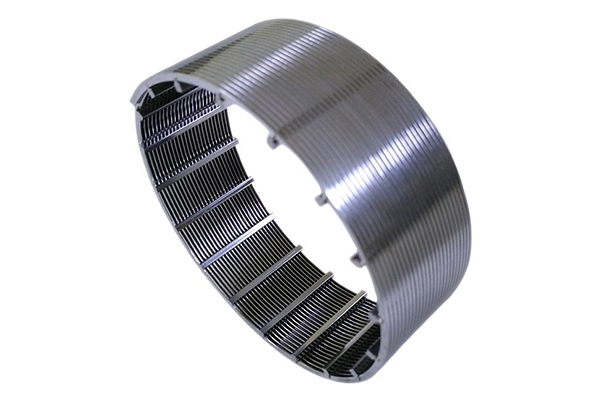
Before choosing any filter, it is important to define the operating challenge.
A wedge wire screen filter is often suitable if your system involves:
• High flow rates with low pressure drop requirements
• Continuous operation where downtime is costly
• Media containing fibers, solids, or irregular particles
• Applications prone to clogging with conventional mesh
• Long service life expectations in harsh environments
If fine micron-level filtration is required, a wedge wire screen may act as a pre-filter, rather than the final filtration stage.
1. Flow Efficiency
The open structure and V-wire profile allow water or process fluid to pass with minimal resistance. Compared to woven wire mesh or perforated plate, wedge wire screens typically maintain higher effective open area at the same cut size.
2. Clogging Resistance
Because the slot opening widens downstream, particles are less likely to become trapped. Solids either pass through or are carried away by the flow, which reduces blinding.
3. Mechanical Strength
The welded construction provides excellent load-bearing capacity. This makes wedge wire screen filters suitable for:
• High differential pressure
• Large-diameter intake systems
• Industrial process vessels
Yes—within defined limits.
Wedge wire screen filters perform well when solids are:
• Fibrous
• Granular
• Irregularly shaped
They are commonly used in:
• Wastewater headworks
• Intake protection systems
• Mining and mineral processing
• Pulp and paper operations
However, if the application requires the removal of very fine particles below the slot size, secondary filtration may still be required.
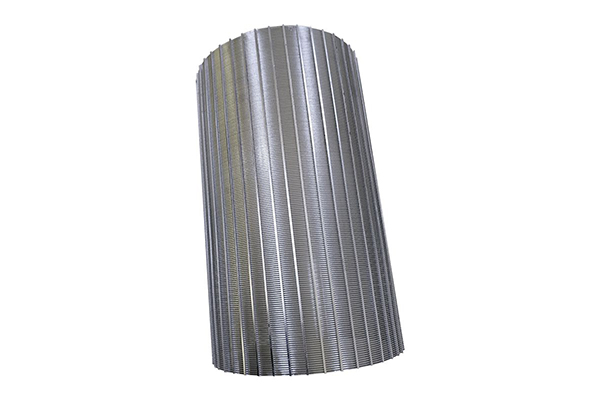
Slot size selection depends on the target particle size and system flow conditions.
Typical wedge wire slot ranges:
• 0.05–0.25 mm for fine screening and intake protection
• 0.25–1.0 mm for industrial process filtration
• >1.0 mm for coarse screening and debris removal
Choosing an overly small slot can increase pressure drop, while an overly large slot may reduce separation efficiency. Proper sizing balances protection, flow, and maintenance frequency.
Material choice plays a critical role in long-term reliability.
• SS304 is suitable for fresh water, neutral pH environments, and general industrial use.
• SS316L provides superior resistance to chlorides, chemicals, and seawater, making it preferred for wastewater, desalination, and chemical processing.
Selecting the correct grade helps prevent corrosion-related failure and unplanned downtime.
One of the main advantages of a wedge wire screen filter is low maintenance demand.
In many systems:
• Cleaning is infrequent
• Backwashing or manual rinsing is sufficient
• No consumable media is required
This makes wedge wire screens attractive for remote or continuously operating facilities.
A wedge wire screen filter may not be ideal if:
• Ultra-fine filtration (<50 microns) is required as the final stage
• Space constraints limit rigid screen installation
• Disposable or low-cost filtration is preferred over long service life
In such cases, cartridge filters, sintered media, or membrane systems may be more appropriate.
A practical decision framework includes:
• Required cut size
• Operating flow rate
• Solid type and concentration
• Chemical and temperature exposure
Maintenance access and cost targets
If your system prioritizes durability, stable performance, and reduced clogging, a wedge wire screen filter is often a strong candidate.
Careful evaluation of system requirements and operating conditions will determine whether a wedge wire screen filter delivers the best balance of performance and cost for your application.
Related Products
Automatic Backwash Self Cleaning Filters
86-15732177595
Jinling Mansion 2 2-3-403, Yuhua Road 106-1, Yuhua District, Shijiazhuang City, Hebei, China
Request a Quote