
Hebei YUBO Filtration Equipment Co., Ltd. Hebei YUBO Filtration Equipment Co., Ltd.
+86 15732177595
Hebei YUBO Filtration Equipment Co., Ltd. Hebei YUBO Filtration Equipment Co., Ltd.
+86 15732177595
A basket strainer is a widely used industrial filtration device designed to remove unwanted solid particles from liquid systems before they reach pumps, valves, heat exchangers, and other downstream equipment. By using a removable filtration basket, it provides an efficient and reusable solution for protecting process equipment and maintaining stable flow conditions.
Definition of Basket Strainer
A basket strainer is a mechanical filtration device that uses a removable perforated or mesh basket element to capture solid contaminants from flowing liquids.
Unlike disposable filters, basket strainers are designed for repeated use. When contaminants accumulate inside the basket, the element can be removed, cleaned, and reinstalled, reducing maintenance costs and minimizing system downtime.
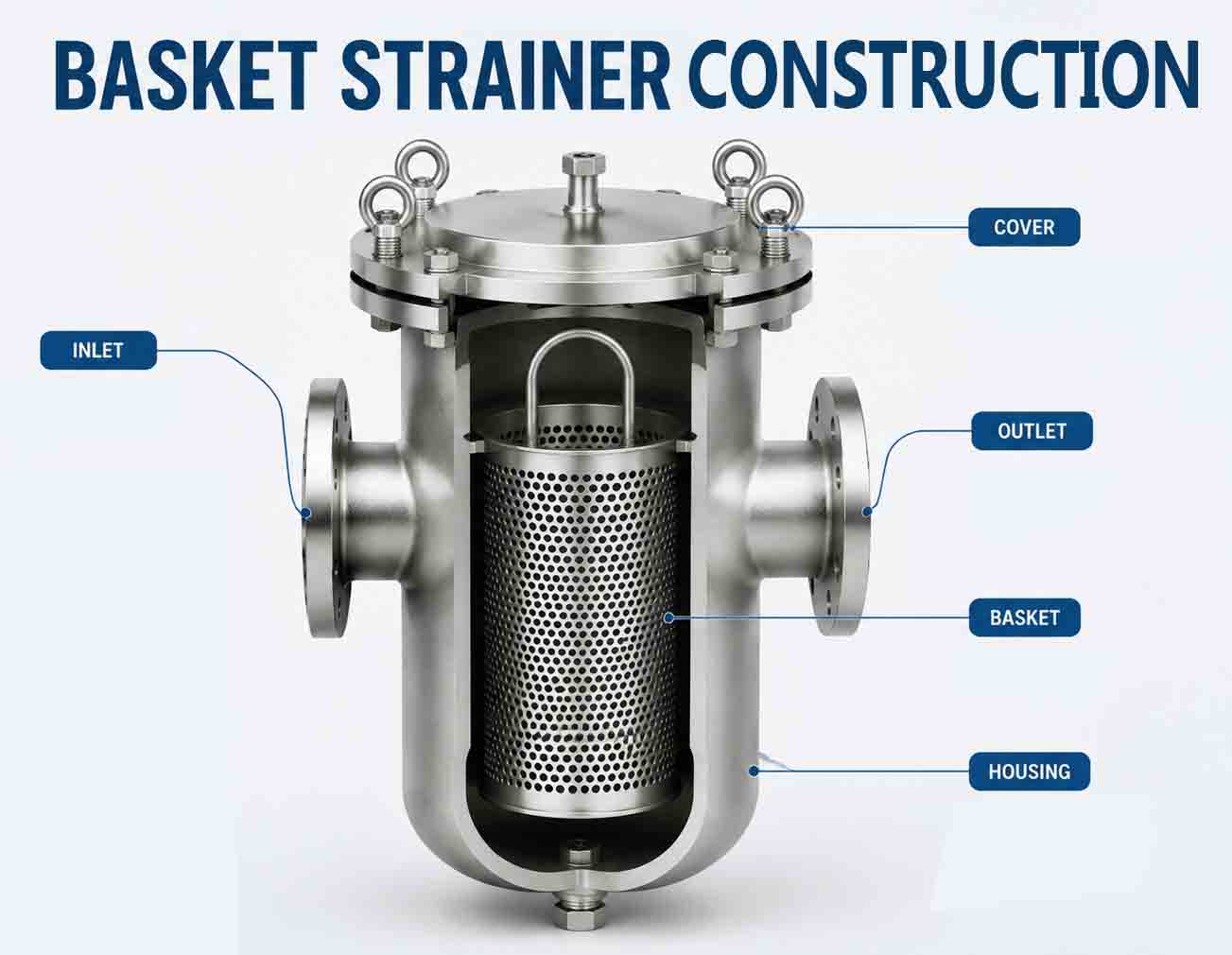
A typical basket strainer consists of a pressure-resistant housing, an internal filtration basket, a cover assembly, and sealing components. Liquid enters through the inlet, passes through the basket, and exits through the outlet after suspended solids are retained inside the filter element.
Basket strainers are mainly used for coarse and medium filtration, protecting sensitive downstream equipment from particles such as:
Dirt and debris
Rust particles
Sand
Pipe scale
Process contaminants
Other suspended solids
Although the terms strainer and filter are often used interchangeably, they serve different filtration purposes.
| Basket Strainer | Filter |
| Mainly removes larger solid particles | Designed for finer particle removal |
| Uses a reusable basket element | May use disposable or replaceable elements |
| Commonly protects pumps, valves, and pipelines | Used for precision filtration applications |
| Usually installed upstream of equipment | Used throughout filtration processes |
Basket strainers are generally selected when the main objective is equipment protection and continuous flow reliability, while filters are typically used when higher filtration accuracy is required.
Working Principle of Basket Strainer
The working principle of a basket strainer is based on physical separation through a porous filtration element.
The filtration process includes the following steps:
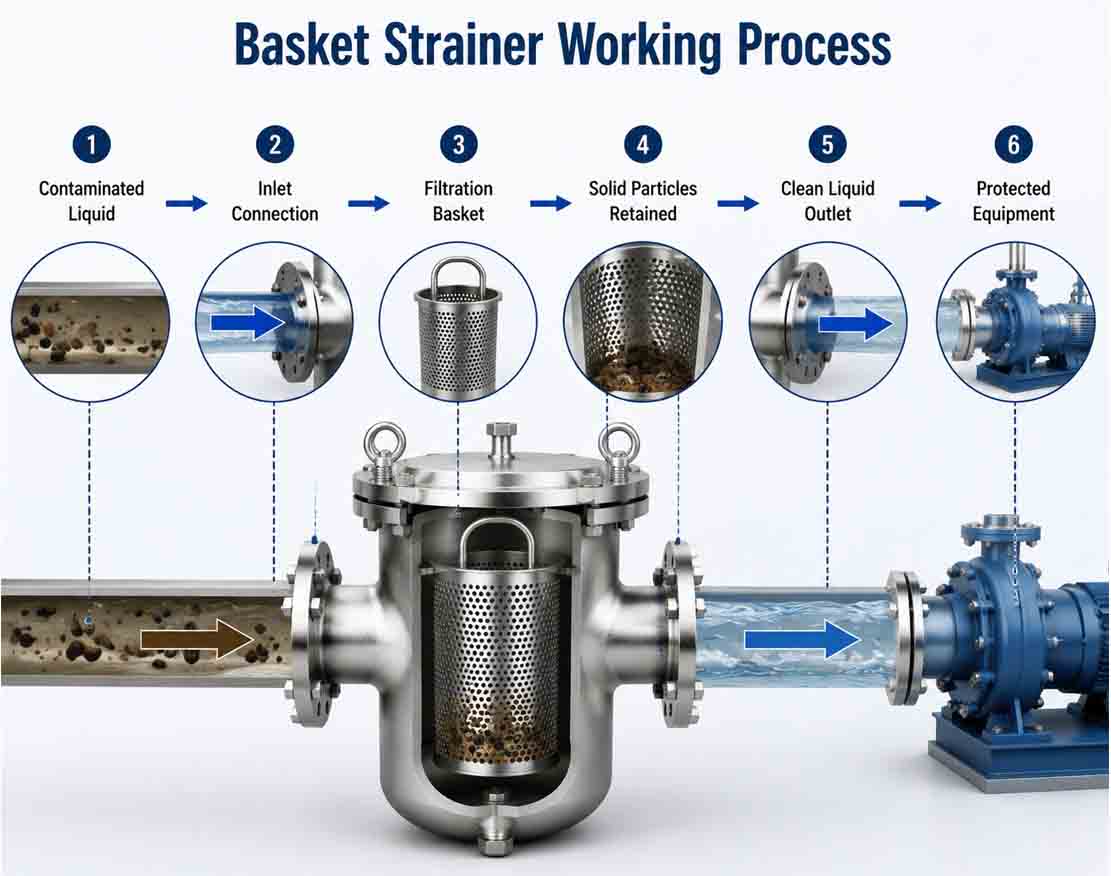
1. Liquid Enters the Strainer
The contaminated liquid enters the basket strainer through the inlet connection and flows toward the internal basket.
2. Liquid Passes Through the Basket
As liquid flows through the basket openings, solid particles larger than the basket openings are trapped on the inner surface of the basket.
3. Clean Liquid Leaves the Outlet
The filtered liquid continues through the outlet and enters the downstream system with reduced contamination levels.
4. Basket Cleaning and Maintenance
As solids accumulate, the pressure drop across the strainer increases. The basket can be removed, cleaned, and returned to service.
This reusable design makes basket strainers suitable for applications requiring reliable filtration with regular maintenance.
Contaminated Liquid
Inlet Connection
Filtration Basket
Solid Particles Retained
Clean Liquid Outlet
Protected Equipment
A basket strainer is composed of several important parts that work together to provide reliable filtration performance.
1. Strainer Housing
The housing is the main pressure-containing body of the basket strainer.
Its functions include:
Providing a flow channel for liquid
Supporting the filtration basket
Withstanding system operating pressure
Protecting internal components
Basket strainer housings are commonly manufactured from materials such as stainless steel, carbon steel, cast iron, and other alloys depending on the application requirements.
2. Filter Basket
The basket is the core filtration component of the strainer.
It captures solid contaminants while allowing clean liquid to pass through.
Common basket designs include:
Perforated metal baskets
Wire mesh baskets
Multi-layer filtration baskets
The basket can usually be removed for cleaning or replacement, making basket strainers a reusable filtration solution.
3. Cover Assembly
The cover provides access to the internal basket.
A properly designed cover allows operators to:
Remove the basket easily
Perform regular inspection
Complete maintenance efficiently
Different closure designs are available depending on pressure requirements and operating conditions.
4. Gasket and Sealing System
The gasket creates a reliable seal between the housing and cover.
A proper sealing system helps:
Prevent liquid leakage
Maintain operating safety
Improve filtration reliability
Gasket materials are selected according to fluid characteristics, temperature, and chemical compatibility.
Types of Basket Strainers
Basket strainers are available in different designs to meet various industrial requirements.
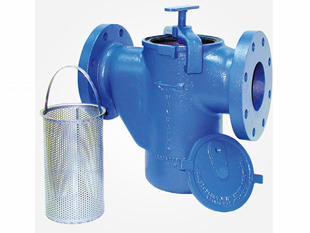
1. Basket Strainer
A standard basket strainer uses a single removable basket and is commonly installed in pipelines where temporary shutdown is acceptable for cleaning.
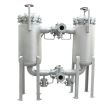
A duplex basket strainer contains two filtration chambers that allow continuous operation.
When one basket requires cleaning, the flow can be redirected to the other chamber without stopping the system.
3. Simplex Basket Strainer
A simplex basket strainer contains one filtration chamber.
4. Stainless Steel Basket Strainer
Stainless steel basket strainers are designed for applications requiring corrosion resistance and durability.
Common materials include:
Stainless Steel 304
Stainless Steel 316
Related Filtration Equipment
Basket strainers are often used together with other industrial filtration equipment.
Basket Filter Housing
Basket filter housing provides a complete enclosure system for basket filtration elements and is widely used in industrial liquid filtration applications.
Industrial Pipeline Filter
Industrial pipeline filters protect equipment by removing contaminants from process fluids before they enter critical components.
Self Cleaning Filter
Self cleaning filters automatically remove accumulated contaminants and reduce manual maintenance requirements for continuous filtration systems.
Basket strainers are used across many industries where liquid contamination control is required.
Water Treatment
In water treatment systems, basket strainers protect pumps, valves, and other equipment by removing suspended solids before further processing.
Applications include:
Water circulation systems
Wastewater treatment
Filtration pretreatment
Chemical Processing
Chemical plants use basket strainers to protect process equipment from solid contaminants while maintaining stable fluid flow.
Typical applications include:
Chemical transfer systems
Process pipelines
Pump protection
Oil and Gas Industry
Basket strainers are commonly installed in fuel and lubrication systems to prevent particles from damaging pumps and mechanical equipment.
Food and Beverage Processing
Stainless steel basket strainers are used where corrosion resistance and hygienic operation are required.
Applications include:
Beverage processing
Liquid ingredient filtration
Processing equipment protection
Power Generation
Power plants use basket strainers to protect cooling systems, pumps, and other equipment from debris and suspended solids.
1. What is a basket strainer used for?
A basket strainer is used to remove solid particles from liquids and protect downstream equipment such as pumps, valves, and heat exchangers.
2. What is the difference between a basket strainer and a filter?
A basket strainer is mainly designed for removing larger particles and protecting equipment, while filters are generally used for finer filtration requirements.
3. How often should a basket strainer be cleaned?
Cleaning frequency depends on the fluid quality, particle concentration, and operating conditions. Regular inspection is recommended to prevent excessive pressure drop.
4. What materials are basket strainers made from?
Basket strainers are commonly manufactured from stainless steel, carbon steel, cast iron, and other corrosion-resistant materials depending on the application.
5. Can basket strainers be reused?
Yes. Most basket strainers use removable baskets that can be cleaned and reused, making them a cost-effective filtration solution.
A basket strainer is an important industrial filtration device used to remove solid contaminants from liquid systems and protect downstream equipment. With a reusable basket element, simple structure, and reliable filtration performance, basket strainers are widely applied in water treatment, chemical processing, oil and gas, food processing, and industrial pipeline systems.
Understanding the definition, working principle, components, and basic types of basket strainers provides a foundation for selecting the right filtration solution for different industrial applications.
Related Products
Automatic Backwash Self Cleaning Filters
86-15732177595
Jinling Mansion 2 2-3-403, Yuhua Road 106-1, Yuhua District, Shijiazhuang City, Hebei, China
Request a Quote